
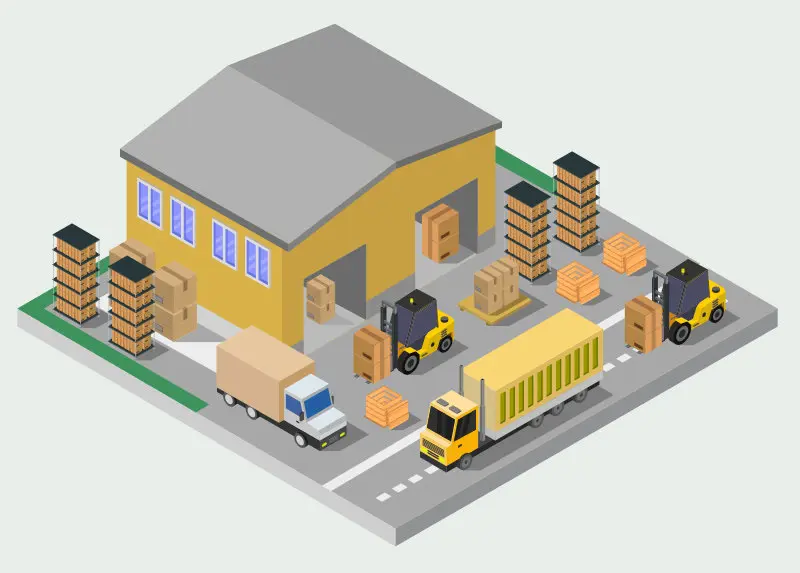
3PL Fulfillment
3PL Fulfillment is an efficient and cost-effective way to outsource warehouse and shipping logistics for e-commerce companies.
This involves outsourcing all or part of a company’s warehousing, inventory management, order processing and shipping services to third-party providers. Three parties (3PL) are involved: the company, the fulfiller and the shipping service provider.
This allows companies to save time, money and resources. It also gives companies access to the latest technology, qualified personnel and other expertise to help them improve their efficiency in managing their warehouses and shipments.
The core business includes:
- Goods receipt,
- Preparation of goods,
- Warehousing,
- Order call-off,
- Order picking,
- Packing,
- Labeling,
- Franking,
- Shipping and
- Returns processing.
Further services
Other services and solutions such as
- Invoicing,
- Dunning system,
- Fiscal representation,
- Customer support,
- Individualization of the products,
- Marketing or
- Web development
are also partly handled by logistics service providers.
Other logistics processes can also include pre FBA (Fulfillment by Amazon) service, international acceptance of returns, cross-docking, cross-border shipment, refurbishment, packaging or print on demand.
Why do online retailers need a 3PL fulfillment service provider at all?
At some point, even the best packer reaches its limits. MyMüsli has also grown considerably and had to operate its own warehouse and hire employees. The question then arises as to whether the company wants to handle everything itself or use a third party as a fulfillment service provider.
Advantages of 3PL fulfillment: If a professional fulfillment service provider is used, costs can be around 20% lower. Order peaks can be better absorbed by more employees. Orders from multichannel channels can be retrieved and bundled by the service provider.
Advantages for in-house fulfillment: Processes can be better controlled to ensure an appropriate quality standard. Specially required interfaces can be developed specifically for the company.
3PL Fulfillment offers solutions for:
- Online retailer D2C,
- Wholesaler B2B or B2C,
- Manufacturer B2B,
- Spare parts warehouse,
- Cross-docking,
- Amazon retailer(pre FBA),
- Book shipping,
- Shipping of advertising material,
- Subscription shipping
Analyze your needs and find the right 3PL provider
To benefit from 3PL fulfillment services, you need to choose the right provider for your needs.
Various providers offer different services, including warehouse and inventory management, order fulfillment, packaging solutions, shipping options and more.
Analyze your current requirements and determine which type of 3PL is best suited for your company.
Consider the size of the orders to be fulfilled (e.g. smaller retail orders or larger B2B orders), geographical considerations for your shipments (international reach for e-commerce) and other factors such as delivery times.
Compare several providers carefully before deciding on a 3PL partner.
What are the differences in Party Logistics (PL)?
“Party Logistic” designates the parties involved in the fulfillment of a task. The terms 1 PL, 2 PL, 3 PL, 4 PL and 5 PL are used.
1PL Fulfillment
Everything from a single source – from a single company.
Regional companies, such as an organic farm, often take care of the entire logistics themselves, including production, storage, order acceptance, as well as assembling and delivering the goods.
Everything from a single source, also known as 1PL (“First Party Logistics“), which means that we take over 100% of all logistics processes ourselves.
Procedure:
Manufacturer ➔ Own warehousing ➔ Order acceptance ➔ Order picking ➔ Packaging ➔ Delivery ➔Returns acceptance
2PL Fulfillment
Two parties involved – companies.
A good example is the company “My Müsli”. Here, the three founders sold thousands of products online via their store, then mixed the muesli varieties themselves for a long time in a very small space and shipped them with an external parcel service provider.
Solutions such as storing and packing goods yourself but using an external parcel service provider are also known as 2PL (“second party logistics“) because all logistics processes are handled by two parties. The manufacturer and the parcel service provider.
Procedure:
Manufacturer ➔ Own warehousing ➔ Order acceptance ➔ Order picking ➔ Packaging ➔ External shipping ➔ Returns processing.
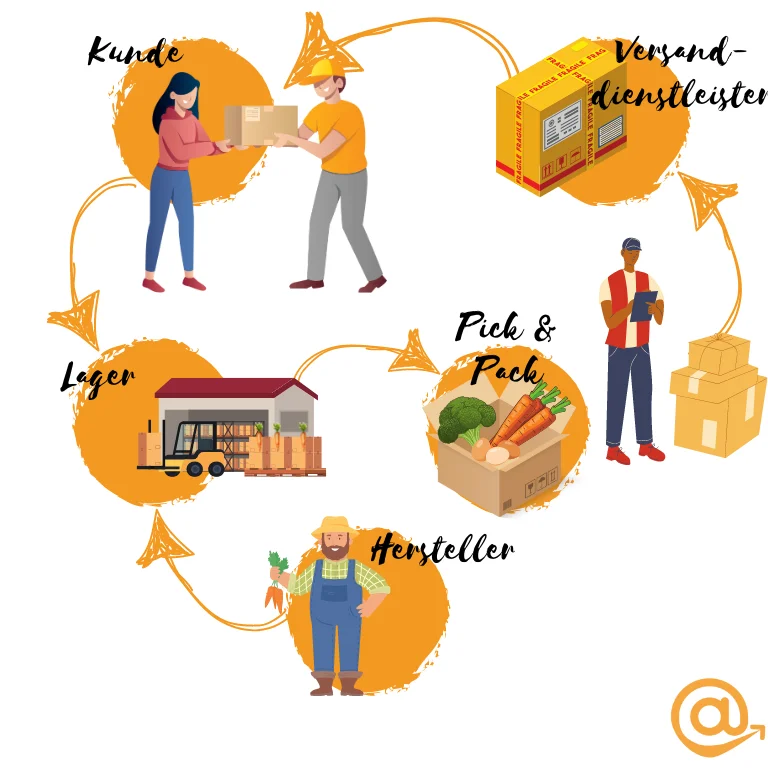
3PL Fulfillment
Classic fulfillment with 3 companies involved.
With the assumption of the above-mentioned core tasks, we also speak of a 3PL (“Third Party Logistics“) fulfillment service provider (Fulfiller). Three parties are involved in logistics here. The manufacturer (retailer), the fulfiller and the parcel service provider.
This service provider handles the entire Border processing. Customer orders are automatically retrieved from the online store via an interface. The goods are The parcelsare stored in the distribution warehouseand the transportation of the parcels to the end customer is handed over to an external shipping service provider such as DHL, DPD, GLS, Hermes or UPS.
Procedure:
Manufacturer (retailer) ➔ External warehousing ➔ Automatic order call-off ➔ Order picking ➔ Packaging ➔ External parcel service providers ➔ Returns management
4PL Fulfillment
Optimization of process flows.
This logistics service provider takes over and monitors parts of the production chain (supply chain), including transportation, without operating a warehouse itself. To this end, individual processes are outsourced to 3PL or 2PL service providers. This could be, for example, taking over the supply of spare parts.
4PL (“Fourth Party Logistics”) logistics is often used in mechanical engineering, car manufacturing or the aircraft industry.
If services are provided for the entire supply chain (supply chain management), including monitoring, this is referred to as 5PL fulfillment.
For which products are fulfillment providers used?
Logistics centers are used by retailers, manufacturers and wholesalers. In retail, the goods are sent to end customers, i.e. D2C (direct-to-consumer), once the order has been received in the store. While intermediaries or manufacturers also ship to wholesalers, i.e. B2B (business-to-business).
Almost every industry can use the fulfillment service. Products can include the following:
- Clothing
- Spare parts
- Sporting goods
- Leisure articles
- Shoes
- Car and bicycle accessories
- Electrical goods
- Kitchen accessories
- Furniture
- Cosmetics and jewelry
- Books and magazines
- Light source
- Bags and cases
- Furnishings
- Food
- much more
Special solutions are required for hazardous goods or bulky goods, for example. Retailers should compare logistics service providers here, as not everyone offers everything.
What types of bearings are there?
The Fulfillment Center offers various types of warehouses.
These include:
- Pallet warehouse
- Small parts warehouse
- Spare parts warehouse
- Shelving racks
- Drive-in racks
- Suspension systems
Outline your requirements for good communication
Make sure you communicate your shipping requirements and goals to PL providers to reduce the risk of errors and misunderstandings when working with them.
Explain the details of picking and packing tasks, such as what type of items need to be shipped regularly, what packing and shipping options need to be used (e.g., refrigerated/frozen shipments or hazardous materials require special packaging and labeling), how orders will be tracked, how inventory will be managed, who will perform quality checks when needed, etc.
Clear communication is essential for successful 3PL fulfillment services.
Ask directly about the solutions for warehousing, order picking, packaging and returns management.
When you work with 3PL fulfillment companies, you have access to high-quality storage solutions and warehouses.
They carry out all necessary processes in connection with the storage of your goods, e.g. scanning items, transferring serial numbers, labeling (barcodes, shipping labels), tracking stock levels, managing inventory data and controlling product flows in and out of the warehouses.
Many 3PLs can also help with challenging products, goods preparation, returns management, packaging optimization and much more.
When choosing a 3PL provider, pay attention to the services they offer so that you can decide whether they are suitable for your company’s requirements.
Measuring performance for greater efficiency
Once you’ve chosen a 3PL provider that offers the right services, it’s time to take a closer look at their performance.
To determine the success of your 3PL fulfillment activities, you should regularly measure the key performance indicators (KPIs). This will help you determine if there are inefficiencies that need to be addressed. By tracking KPIs such as delivery accuracy, on-time deliveries and inventory damage rates, you can identify areas where performance could be improved.
Make adjustments as needed to ensure your 3PL provider meets your expectations.
How much does the fulfillment service cost?
This is of course slightly different for every logistics company and also depends on the products offered by the online retailer in e-commerce. It is worth comparing several offers here.
In general, the costs for incoming goods, storage, goods preparation, picking, outgoing goods and returns management are calculated.
In the warehouse, the storage space used is calculated per cubic meter or per pallet.
Incoming goods, order processing with outgoing goods and returns are often calculated per item or carton.
Not all tasks can be priced in advance and some have to be charged on an hourly basis.
Some charge monthly basic fees, support fees or fees for outsourcing.
How does the software connection work?
Once the partners have settled the contractual aspects, the technical integration takes place. For this purpose, the online store or ERP system is connected to the fulfillment provider’s merchandise management system via an API interface.
Frequently used software solutions such as Shopware, WooCommerce, CosmoShop, Gambio or Shopify can often be connected very easily and quickly.
When using multichannel platforms or rarely used store systems, sellers should manage orders via an ERP system such as billbee or weclapp and transfer them to the ERP system.
Orders are automatically retrieved by the software and stock levels are updated. Customers also have access to a dashboard that displays every transaction and the status of the order.
Some work processes should be carried out as a test. Partial quantities of the goods can be delivered and stored at the same time.
The collaboration and dispatch of the goods can then begin.
Fulfillment provider
3 PL fulfillment providers for large companies
- DHL
- DPD
- UPS
- Hermes
- Amazon
- Kühne + Nagel
- Fiege
- Active Ants
3 PL Fulfillment providers for small and medium-sized enterprises (SMEs)
- Subke
- Beckmann
- Rhiem
- Lufapak
- LSM
- Easyfulfillment
- 004
- Zenfulfillment
- VDS
3 PL Network provider
- byrd technologies
- Warehousing 1
- YouSellWeSend
- Fulfillmentscout
- Scoutconcept
- LogiVisor
+ Advantages
Distribution warehouse. Your goods and containers can be delivered directly to the warehouse, unpacked and stored more quickly.
More employees. Several employees are available in the warehouse if needed.
Customer satisfaction. Established processes and experienced team members ensure fast shipping with secure packaging and returns processing.
Reduce fixed costs. They themselves have no fixed costs for storage and employees.. The costs vary according to demand.
Heated bearings. You can use secure and heated storage facilities that are frost-proof and dry for your goods.
Scalability. With a view to growth, you gain more flexibility for your business and can use the logistics services as required.
– Disadvantages
Dependence. You need to be able to rely on your fulfillment partner to ensure that order processing runs smoothly.
Bulky goods or dangerous goods. If you sell specialized products that fall under this category, you may find it difficult to find a supplier.
Valuable goods. Not every center has the facilities required by the insurance company to store very valuable goods such as genuine jewelry.
Storage insurance separately. You must inform your warehouse insurance company that you are using an external warehouse. Or obtain storage insurance for your goods from the Fulfiller.
changeover phase. Depending on the provider, there may be delays in the connection process. The experience of the fulfiller and the previously considered processes are decisive here.
Questions about 3PL Fulfillment
What does fulfillment mean?
Fulfillment is an English term that translates into German as fulfillment, execution or performance from a single source. However, the term is also used in the private sphere for life fulfillment and self-realization.
The word can be spelled “fulfillment” or “fulfillment”.
Fulfillment is a sub-area of logistics with the assumption of order fulfillment for retailers and manufacturers.
A fulfillment provider is also known as the “fulfiller”.
What are micro fulfillment centers?
These are small logistics centers in the middle of the city. Their aim is to deliver frequently purchased goods to customers on the same day (“same-day delivery”). Bicycle couriers are often used in the delivery centers.
What is a Fulfiller?
The fulfiller is the person who performs the fulfillment service. This is also an English word that translates into German as “Erfüller”.
What does eFulfillment mean?
The word eFulfillment is a combination of e-commerce and fulfillment. This refers to automatic order retrieval via a store connection to the online store with order processing for online retailers.
While Fulfillment also handles manual orders for wholesalers.
What are the advantages of outsourcing?
If a company uses the services of a fulfillment provider, advantages such as time savings, lower fixed costs, storage of products at several locations, fast processing and coverage of order peaks can arise.
The time saved can be used by the entrepreneur for marketing, product development or for the online store.
The entrepreneur uses well-established processes with a logistics partner, which can lead to greater customer satisfaction when processing orders.
External fulfillment providers can also be used flexibly as required. A particular advantage during peak order periods such as Christmas, Black Week or Cyber Monday.