

Key Points at a Glance:
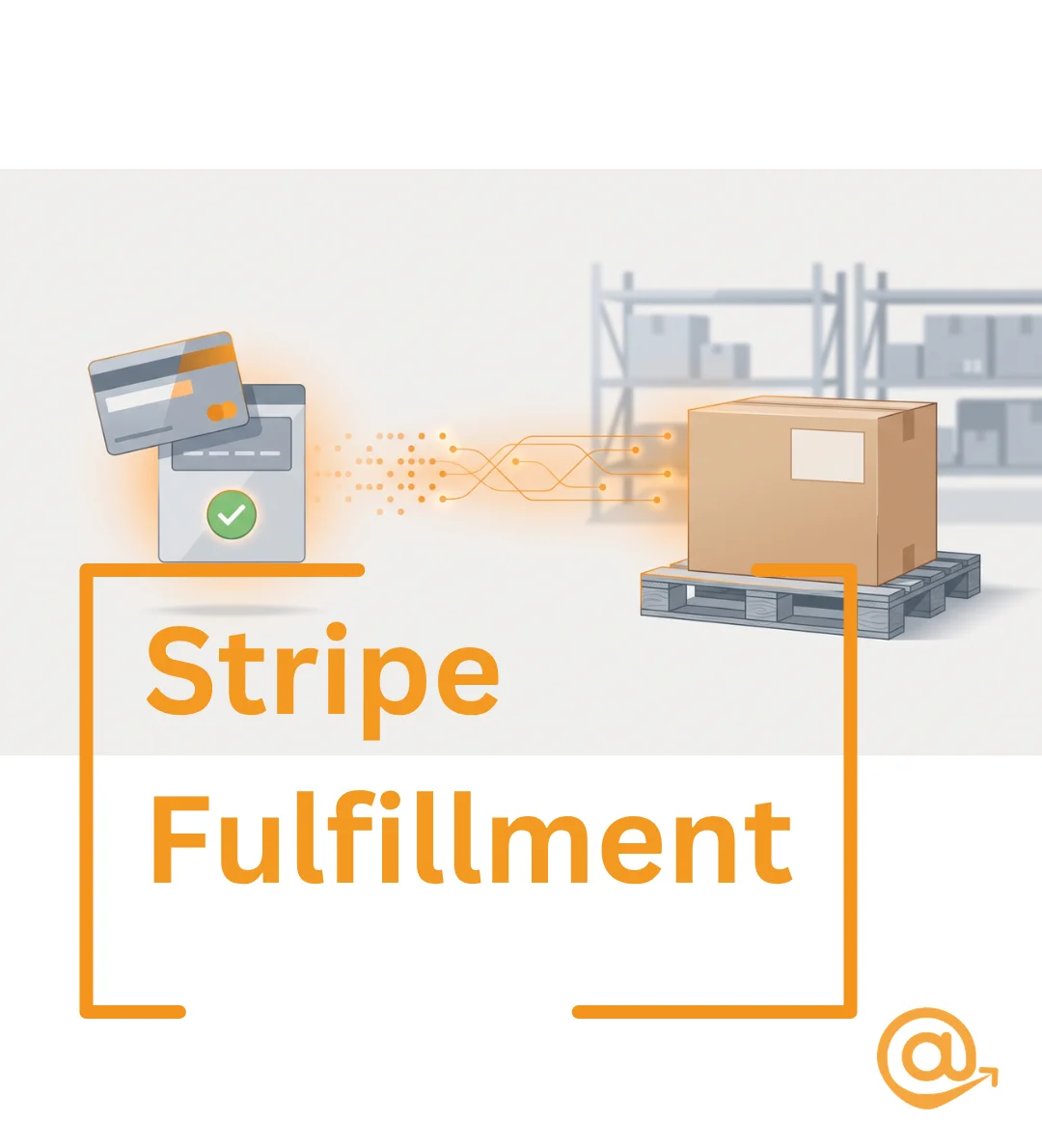
Stripe is treated as a store system in ffn-connect—orders come from paid checkout sessions.
- The integration requires a restricted API key with write permissions; with read-only permissions, inventory and tracking updates will not take effect.
- Stripe does not track inventory: When stock reaches 0, the product is automatically archived and disappears from Payment Links and Checkout.
- Stripe is one of the two major agent-commerce providers—anyone selling through Stripe today is already using the infrastructure through which AI agents will make payments in the future.
What Stripe Offers Online Retailers
Stripe is primarily a payment service provider, but one with an unusually low barrier to entry. There are no setup or monthly fees; billing is on a per-transaction basis.
In Germany, standard cards from the EEA (European Economic Area) cost 1.5 percent plus 0.25 euros, premium cards cost 2.8 percent plus 0.25 euros, and cards from outside the EEA cost 3.15 percent plus 0.25 euros. A SEPA direct debit costs 0.35 euros. With Klarna, fees start at 2.99 percent plus 0.35 euros (Stripe pricing overview ➚, accessed September 9, 2026).
For retailers, four points are particularly important:
- Over 100 payment methods from a single account—cards, SEPA, Klarna, and digital wallets. For international sales, this eliminates the need for individual contracts.
- Payment links and checkout without your own online store. Create a product, generate a link, share it. For small product lines, pre-sales, trade show sales, and social selling, this is the fastest way to generate your first revenue.
- Radar as an integrated fraud detection system that runs with every transaction.
- Payouts and accounting are handled through the same interface as payments, including receipts and refunds.
What Stripe isn’t: an inventory management system. It doesn’t track inventory levels, product variants, or order statuses. The fulfillment integration fills this gap.
The really interesting point: Agentic Commerce
Our article“Agentic Commerce: When AI Agents Go Shopping” explored the question of how online stores are becoming machine-readable. Stripe is listed there as a co-author of the Agentic Commerce Protocol (ACP), which the company released in collaboration with OpenAI in September 2025 under the Apache 2.0 license.
It has since evolved into a full suite of products. The Agentic Commerce Suite, available since December 11, 2025, consists of three components: Stripe Blog ➚:
- Product discovery via an ACP endpoint hosted by Stripe, which provides AI agents with product data in real time.
- Checkout via the Checkout Sessions API, including tax and shipping calculations.
- Payment processing via shared payment tokens —one-time tokens that allow an agent to make a payment without ever seeing card information. Radar verifies the transaction as well.
In addition, there is an Agent Wallet via Stripe Link, which allows agents to make purchases within set spending limits; the Machine Payments Protocol for machine-to-machine payments; and Issuing for Agents for virtual cards.
Stripe lists Etsy, Coach, Kate Spade, Revolve, and the URBN Group, among others, as users of the suite. It integrates with platforms such as WooCommerce, Wix, BigCommerce, and Squarespace.
The appeal for small merchants is that they don’t have to purchase this infrastructure separately. It’s linked to the same Stripe account used for processing payments anyway.
And now for the counterargument. The protocol’s most prominent use case, OpenAI’s Instant Checkout in ChatGPT, was discontinued in March 2026—only about a dozen Shopify merchants had gone live with it prior to that, according to Digital Commerce 360. And in Germany, only 9 percent of consumers would let AI handle their entire shopping experience, including payment, according to ECC Köln ➚. Anyone switching to Stripe today because of Agentic Commerce is buying an option on the future, not an ongoing revenue channel.
The integration with fulfillment is worthwhile regardless—and it’s a prerequisite for the future scenario to work at all. An agent will only buy what is reliably available. In this setup, whether a Stripe product remains visible to an agent depends directly on the inventory on hand.
Here’s how to integrate Stripe via ffn-connect
ffn-connect is the middleware of the JTL Fulfillment Network. It acts as an intermediary between your sales channel and our warehouse, which serves as your fulfillment provider. The Stripe integration process consists of six steps.
1. Create a restricted API key in Stripe. In the Stripe dashboard, go to Developers → Manage API Keys and create a restricted key, for example, with the name “FFN Connect.” The key begins with “rk_live_.”
2. Set permissions. This is where it is determined whether the connection works properly:
| Resource | Required Permissions | Purpose |
|---|---|---|
| Checkout Sessions | Read | Retrieve Orders |
| Products, including prices | Reading and Writing | Import products, update availability |
| PaymentIntents | Read and Write | Resolve payment for order, set tracking |
| Batches | Write | Save shipping details at checkout |
Read permissions alone are not enough. Without write permissions for products, PaymentIntents, and charges, inventory and tracking updates will have no effect—and no error message will be generated.
Second stumbling block: A key from test mode (`rk_test_`) passes the connection test without any problems, but then retrieves only test orders.
3. Create a sales channel. In the Fulfillment Portal, go to Sales Channels → Add Sales Channel, select Stripe, enter the key, test the connection, and continue.
4. Synchronize and approve items. Using “Synchronize Products,” ffn-connect retrieves your Stripe product catalog. You then approve the items for your fulfillment service provider in the main menu under “Items” —without this approval, every order will be held up. Product management itself remains entirely within Stripe: ffn-connect does not create, modify, or delete anything there.
5. Start the order retrieval process. Only completed and paid checkout sessions are imported. As long as no start date is set, ffn-connect intentionally retrieves nothing—otherwise, old inventory that’s been sitting in the warehouse for years will be included. Set a date in the near future, typically today’s date. The *Always automatically request fulfillment* toggle controls whether orders are automatically sent to the warehouse after that date.
6. Assign shipping methods. Each shipping method on your channel is assigned once to a shipping method offered by your service provider; this must include a default shipping method. However, the drop-down list will not populate until your fulfillment provider has approved your warehouses and shipping methods—this is the most common roadblock in the entire setup process and can only be resolved in collaboration with them. ffn-connect, Setup from A to Z ➚.
Two things you should know
Inventory determines visibility. Because Stripe does not track quantities, ffn-connect transmits only an availability signal instead of a number: If warehouse inventory drops to zero, the product is archived in Stripe and disappears from Payment Links and Checkout. When new stock arrives, it is automatically reactivated. If you manage your Payment Links yourself, you can disable inventory synchronization in the channel settings.
The tracking number works for you. After shipment, ffn-connect updates the payment’s shipping details with the tracking number and shipping carrier. Stripe automatically uses this information as evidence in payment disputes—proof of delivery significantly strengthens your position in the event of chargebacks. For orders without a shipping address, this information is instead sent as metadata (`tracking_number`, `carrier`) to the PaymentIntent.
Where the Boundaries Lie
Stripe is not a replacement for a shopping cart system, and this article would be misleading if it failed to mention that. Here are three things you should know beforehand:
- No variants. Each Stripe product becomes a separate item. As a result, a product line with different sizes and colors can quickly become confusing.
- No order numbers. Stripe does not assign order numbers, so the checkout session ID (`cs_…`) serves as the order number. This makes it difficult to handle inquiries over the phone.
- No order status. Stripe does not track shipping status; the status of your payment does not change as a result of fulfillment.
Our assessment: For a manageable product lineup without variations, as well as for pre-sales, bundles, and direct sales via social media, the Stripe integration is a streamlined, fast solution.
As soon as you need product variants, customer accounts, or a more complex product structure, a storefront system or an ERP system is the better sales channel—we also integrate both via ffn-connect; see our overview of fulfillment interfaces.
Where Subke Comes In
ffn-connect always connects two parties: your sales channel and a warehouse. We are the second party. As a fulfillment service provider, we operate three warehouses totaling 18,000 m² in Adendorf, Lüneburg, and Kirchgellersen in the Lüneburg district.
The warehouses are located about 42 kilometers south of Hamburg. We serve over 400 customers, support more than 35 store and ERP interfaces, pick orders with 99 percent accuracy, and have a cutoff time of 11:00 a.m.
Shipping is handled by Deutsche Post, DHL, GLS, and DPD; you can also integrate your own shipping contract.
Specifically, for your Stripe integration, this means: We’ll enable warehouse and shipping methods for you in ffn-connect, add your products to the warehouse, and report inventory levels and tracking numbers back to Stripe—the two factors that determine the visibility of your products in Stripe and your status regarding chargebacks.
If you’d like to know whether your product lineup is suitable for Stripe, please contact us. We’ll walk you through the setup process together.
